
You have likely spent hours crafting the perfect blog post, optimizing every header, and hitting publish, only to hear crickets. The content was good, but the traffic never came. This is the most common frustration for content creators and affiliate marketers: fighting for keywords you cannot win.
The solution isn't to write more; it is to research smarter. Instead of battling established giants for high-volume terms, you need to find the "low-hanging fruit": specific, lower-competition phrases that larger sites ignore but that real buyers are searching for.
Finding low competition keywords that convert is about identifying gaps in the market where user intent is high, but supply is low. By shifting your focus from vanity metrics like massive search volume to practical metrics like intent and "winnability," you can build a traffic engine that generates leads and sales, not just empty clicks.
This guide will walk you through the exact process of identifying these hidden gems, validating them against real search results, and using tools like ProofWrite to structure your content for victory.
What Is a Low Competition Keyword?
A low competition keyword is a search term that newer or smaller websites can rank for because top-ranking results have low domain authority, poor content quality, or lack direct relevance to the query.
Typically, these keywords have lower Keyword Difficulty (KD) scores and often lower search volumes. However, the true definition of "low competition" goes beyond software metrics. It involves analyzing the Search Engine Results Page (SERP) to see who is ranking. If you see forums like Reddit, question-and-answer sites like Quora, or outdated articles from 2018 in the top positions, you have found a low competition keyword. These are signals that Google is starving for better content to serve its users.
Why You Should Stop Chasing High Volume
New site owners often make the mistake of sorting keyword lists by "Search Volume" and picking the biggest numbers. This is a trap. High volume almost always correlates with high competition. If you try to rank for "best credit card" (volume: 100k+), you are competing with Forbes, Yahoo Finance and NerdWallet.
Instead, targeting a long-tail variation like "best credit card for college students with no credit history" might only have 200 searches a month, but the competition is manageable, and the intent is specific. Ranking #1 for a 200-volume keyword will bring you more traffic than ranking #50 for a 100,000-volume keyword.
Step 1: Shift Your Mindset from Volume to Intent
Action: Ignore vanity metrics and focus on what users actually want.
Before you open a single tool, you must accept a counterintuitive truth: Low search volume does not mean low value.
Many keyword tools rely on historical data that can lag by months. A keyword showing "0-10 searches/month" might actually be trending or simply underreported. SEO experts often refer to these as "Zero Search Volume" (ZSV) keywords. According to Exploding Topics, targeting these underserved terms is a viable strategy because they often represent specific, urgent questions that major competitors haven't bothered to answer.
Furthermore, you need to prioritize Commercial Intent over informational curiosity.
- Informational: "What is SEO?" (User wants a definition; unlikely to buy).
- Commercial: "Best SEO tool for small business" (User is comparing options; ready to buy).
Success Check:
- Are you willing to target keywords with less than 100 estimated monthly searches?
- Does the keyword imply the user has a problem they need to solve now?
Step 2: Start with Broad Topic Research
Action: Identify the "seed" topics for your niche to generate a baseline list.
You cannot find a needle in a haystack if you don't know which haystack to look in. Start by identifying the broad categories of your niche. If you are an affiliate marketer in the "home coffee" niche, your broad topics aren't just "coffee." They are:
- Espresso machines
- Pour-over brewing
- Coffee bean subscriptions
- Burr grinders
Type these broad terms into a research tool or Google itself. This isn't your final list; this is the raw material. You are looking for the "shoulder niches": topics adjacent to the main topic that are less crowded.
Why this matters: Most people stop at the broad topic. By listing out specific sub-niches (e.g., "manual burr grinders for travel"), you naturally move away from the hyper-competitive head terms.
Step 3: Use AI for Long-Tail Brainstorming
Action: Leverage AI to find the conversational phrases that tools often miss.
Standard keyword tools are great for data, but they sometimes lack creativity. AI tools like ChatGPT are excellent at simulating human search behavior.
How to do it: Use a specific prompt to generate ideas. Try this: "Act like an expert in [YOUR NICHE]. Suggest 20 low-competition, long-tail keywords related to [TOPIC]. Focus on 'how-to' questions, 'vs' comparisons, and specific problem-solving queries that a beginner would type. Prioritize keywords that imply the user is looking to buy or sign up."
AI models are trained on vast amounts of internet text, so they can predict natural language patterns better than some database-driven tools. They can surface questions like "is a manual grinder better than electric for french press," which is a perfect long-tail target.
Success Check:
- Do the suggestions sound like something a real human would say to a friend?
- Are the phrases 4 words or longer? (Longer phrases usually have lower competition).
Step 4: Mine Question-Based Keywords
Action: Discover exactly what users are asking using specialized tools.
Questions are the gold standard of low competition keywords. When someone types a full question into Google, they are looking for a direct answer, and these queries often trigger "Featured Snippets" or AI Overviews.
Use a tool like AlsoAsked.com. When you type in a broad term, it maps out the "People Also Ask" data from Google. This shows you the hierarchy of user curiosity.
- Broad: "Protein Powder"
- Specific: "Does protein powder expire?"
- Niche/Low Comp: "Is it safe to drink protein powder 2 years after expiration?"
The deeper you go into these question branches, the less competition there is. Large brands often ignore these specific questions because the volume seems too low to impact their bottom line, making them perfect for you.
Step 5: Analyze Metrics with ProofWrite
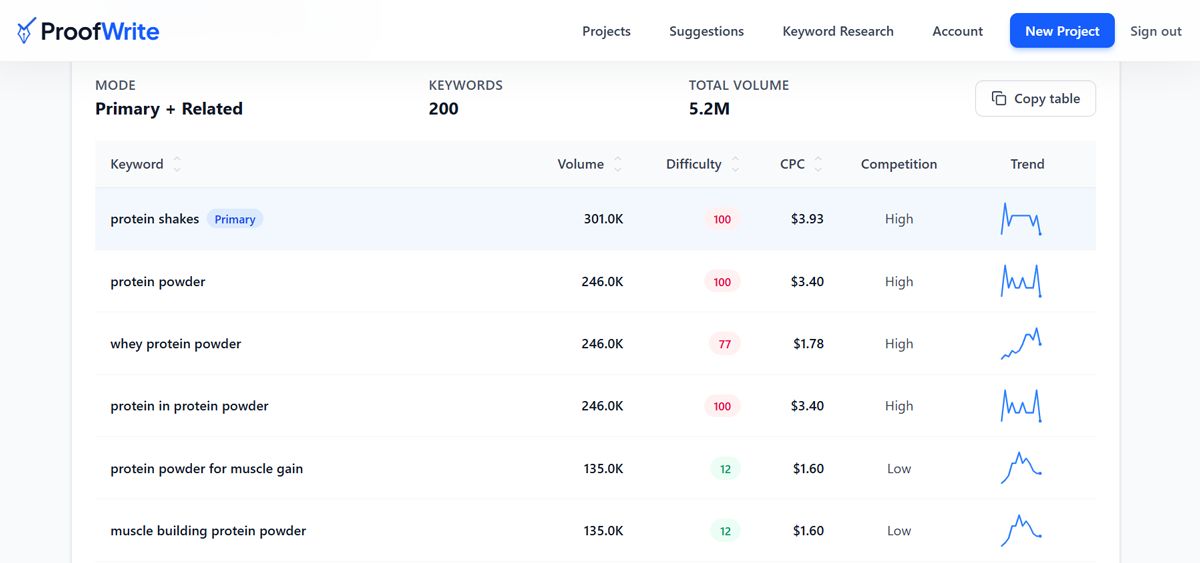
Action: Validate your brainstormed list using real data to separate winners from losers.
Once you have a list of potential ideas, you need to verify if they are actually winnable. This is where you move from guessing to data-driven decision-making.
ProofWrite has built-in keyword research capabilities designed to streamline this process. When you input your seed keywords or brainstormed list into ProofWrite, you get a clear dashboard of the metrics that actually matter for ranking.
What to look for in the data:
- Difficulty Score (0-100): This is your primary filter. If you are a new site, look for keywords with a low difficulty score. ProofWrite calculates this based on the strength of the current top results. A lower score means the current "king of the hill" is weak and can be toppled.
- CPC (Cost Per Click): This is a secret weapon for finding converting keywords. CPC tells you what advertisers are willing to pay for a click on that keyword.
- High CPC ($5.00+): Advertisers know this keyword leads to sales. Even if the search volume is low, a high CPC indicates high commercial value.
- Low CPC ($0.10): The traffic might be there, but the commercial intent is likely low.
- Keyword Prioritization: ProofWrite identifies your main target keyword and prioritizes supporting keywords by search volume and relevance. This matters because ranking for one keyword isn't enough. When you research keywords in ProofWrite, you see which terms have the best volume-to-difficulty ratio, so you can write one comprehensive guide that targets your primary keyword while naturally covering related terms that share search intent.
Pro Tip: Don't just look for green lights. Look for the "Golden Ratio": Low Difficulty + Moderate/High CPC. This is the sweet spot where money is changing hands, but SEO competition is low.
Step 6: Validate Commercial Intent
Action: Filter your list for "Money Keywords."
You have found keywords with low difficulty. Now, ensure they convert. As noted by Productive Blogging, finding keywords is only half the battle; finding ones that drive action is the goal.
Scan your list for these modifiers:
- Best: (e.g., "Best running shoes for flat feet")
- Review: (e.g., "ProofWrite review 2026")
- Alternative: (e.g., "Best Jasper alternative")
- Vs: (e.g., "ConvertKit vs Mailchimp")
- For [User Type]: (e.g., "CRM for freelance photographers")
These modifiers signal that the user is at the bottom of the funnel. They aren't asking "what is a CRM"; they know they need one and are trying to decide which one to buy. A keyword with 50 searches a month containing the word "best" or "buy" is often more valuable than a generic term with 1,000 searches.
Step 7: Manual SERP Analysis (The "Eye Test")
Action: Manually search your target keyword in Google to confirm the opportunity.
Never trust a tool's difficulty score blindly. You must perform a manual check. Type your keyword into Google (preferably in Incognito mode) and look at the top 10 results.
Signs of a Low Competition Opportunity:
- User-Generated Content (UGC): If you see Reddit threads, Quora answers, or forum posts in the top 3 results, this is a massive green light. Google prefers to rank authoritative articles. If it is ranking a Reddit thread, it's usually because there is no good article available.
- Low Domain Authority Sites: Are the top results from small blogs you've never heard of? If a site with low authority is ranking, you can too.
- Poor Content Quality: Click on the top result. is it short? Is it poorly formatted? Is it a wall of text with no images? If you can create something significantly better, the keyword is yours.
- Outdated Content: If the #1 result was written in 2019 and hasn't been updated, Google is looking for a fresh perspective.
According to a discussion on Reddit regarding finding zero volume keywords, spotting these weak spots in the SERPs is often more reliable than any software metric. If the current results don't fully answer the user's intent, the door is open for you.
Step 8: Create a Scalable Content Strategy
Action: Build content clusters rather than isolated posts.
Once you have identified a winning low-competition keyword, don't stop there. Use ProofWrite's keyword research to explore related terms around the same topic.
For example, if you find a great keyword like "how to clean a leather watch strap," don't just write that one post. Research related queries to find other low-competition terms like "how to remove smell from leather watch strap" or "best oil for leather watch straps."
By creating a cluster of content around these related low-competition terms, you build Topical Authority. Google sees that you are an expert on "leather watch strap maintenance," which eventually helps you rank for the broader, more competitive terms.
Success Check:
- Have you planned 3-5 articles around your main topic?
- Are you interlinking these articles to pass authority between them?
Common Mistakes to Avoid
Even with the right tools, it is easy to fall into traps that kill your conversion rates.
1. Ignoring "Zero Search Volume"
As mentioned earlier, many people delete keywords with "0" volume from their lists. Criminally Prolific highlights that these keywords are often where the highest ROI lies. A keyword with "0" volume might actually get 10-20 highly targeted searches a month. If you rank for 50 of these "zero volume" keywords, you could be getting 500-1,000 highly qualified visitors a month who are ready to buy.
2. Targeting Keywords Too Broad for Your Site Age
If your site is three months old, do not target "best laptop." It doesn't matter how good your content is; you lack the "link juice" to compete. Stick to the "long tail" until you have built enough authority to move up.
3. Forgetting the "Convert" Part
Traffic is vanity; profit is sanity. You can rank #1 for "funny cat memes" and get 50,000 visitors, but if you are selling enterprise software, that traffic is worthless. Always ask: Can this person become a customer? If the answer is no, the keyword isn't worth your time, regardless of how easy it is to rank.
FAQ
How long does it take to rank for low competition keywords?
It typically takes 2 to 6 weeks to rank for true low-competition keywords, assuming your content is indexed and high quality. Unlike high-competition terms which can take year, low-competition "long tails" allow new sites to see traction much faster because there are fewer obstacles in the way.
What is a good Keyword Difficulty (KD) score to target?
For a brand new website, target keywords with a KD score of 0-20. As your site gains authority (backlinks and age), you can start targeting the 20-40 range. ProofWrite's difficulty meter gives you a visual indication of this; stick to the "easy" or "very easy" zones when starting out.
Why do some low competition keywords have high CPC?
A high CPC on a low-competition keyword usually means the term is highly specific and lucrative. For example, "emergency plumber in [small town]" has low search volume and low SEO competition, but high CPC because one click can lead to a $500 job. These are excellent targets for local lead generation.
Can I use AI to write the content for these keywords?
Yes, but you must edit and humanize it. Since low-competition keywords often have specific nuances, raw AI output might miss the mark. Use ProofWrite to research keywords and draft the content, then ensure the final content provides unique value that the current top-ranking pages (often weak or automated) lack.
Conclusion
Finding low competition keywords that convert isn't about tricking the algorithm; it's about serving the user better than anyone else. By shifting your focus from "how much traffic can I get" to "how many problems can I solve," you unlock a sustainable path to growth.
Remember the formula: Low Difficulty + High Commercial Intent + Weak SERP Competition = Opportunity.
Don't be afraid of small search volumes. A small stream of buyers is worth infinitely more than a flood of browsers. Start by identifying your niche questions, validating them with ProofWrite's data, and checking the SERPs manually. If you see a forum post ranking #1, that is your invitation to take the top spot.
Ready to find your first winning keyword? Open ProofWrite, input your seed topic, and start filtering for those high-CPC, low-difficulty gems today.

Written by
Jussi Hyvarinen - Co-founder of ProofWrite
I built this platform to solve my own frustration with slow research and generic AI. I use it to write every article you see on this blog, including this one.
Publish articles where every claim is checked
ProofWrite researches and writes articles and checks every factual claim against its sources.
Try it on an article you already wrote.
Free Pilot: 1 article and 3 of your own articles. No credit card.