
The question isn't whether AI can write your blog posts anymore; we know it can. The real question facing content marketers and bloggers today is whether that AI-generated content can actually rank on Google.
If you have used ChatGPT for blogging, you have likely felt the initial rush of generating a 2,000-word draft in seconds, followed immediately by the tedious reality of the cleanup process. You spend hours fact-checking hallucinations, removing cliché scene-setting like "in today’s fast-paced world..." and "in the ever-evolving landscape..." and manually optimizing for keywords because the AI has no concept of search volume.
As a content platform that serves bloggers and content marketers, we built ProofWrite specifically because we experienced the pain points of using ChatGPT for SEO blog content firsthand. The output reads well but lacks the research depth, keyword optimization, and fact-grounding that Google rewards.
We found ourselves spending more time fact-checking, adding citations, optimizing for keywords, and reformatting for WordPress than we saved on the initial draft. That's why we built an end-to-end pipeline that handles research, generation, optimization, and publishing in one workflow.
This guide compares ProofWrite and ChatGPT head-to-head, analyzing which tool is the right fit for your content strategy based on research capabilities, SEO performance, accuracy, and total cost.
What is the main difference between ProofWrite and ChatGPT?
The main difference is that ProofWrite is a specialized SEO content platform built to research, verify, and rank articles, whereas ChatGPT is a general-purpose AI chatbot. While ChatGPT excels at brainstorming and conversational drafting, ProofWrite automates the entire publishing workflow, including live SEO scoring, multi-source fact verification, and one-click WordPress publishing, specifically designed to meet Google's E-E-A-T standards.
The Generalist vs. The Specialist
Think of ChatGPT as a brilliant, incredibly fast intern who has read the entire internet but has no specific training in SEO or journalism. You can ask it to write a blog post, and it will give you text that sounds plausible. However, it doesn't inherently know how to structure an article for search intent, it can't check live keyword data, and it often invents facts to fill gaps in its knowledge.
ProofWrite is designed as a senior SEO editor. It doesn't just "guess" the next word; it follows a rigid, data-driven pipeline. Before it writes a single sentence, it scrapes live data from competitors, review sites, and official product pages. It enforces SEO guidelines during the drafting process, not after, ensuring the final output is ready to rank.
Feature Comparison Matrix
To give you a quick overview of where each tool fits in the content stack, here is a breakdown of their core capabilities for blog writing.
Feature | ChatGPT (Plus/Pro) | ProofWrite |
|---|---|---|
Primary Use Case | Brainstorming, coding, emails, general chat | SEO blog writing, affiliate content, product reviews, guest posts |
Research Method | General web search (Deep Research/o3) | Structured multi-source scraping (Trustpilot, Reddit, Capterra) |
SEO Optimization | None (requires external prompts/tools) | Live SEO scoring (0-100) & Keyword integration |
Fact Accuracy | Prone to hallucinations | Built-in fact-checking with inline verification |
Trust Signals | None | Aggregates real ratings, sentiment & review counts |
Publishing | Copy-paste required | One-click WordPress publishing |
E-E-A-T Compliance | Manual prompting required | Native enforcement of Google Quality Guidelines |
Pricing | $20/mo (Plus) - $200/mo (Pro) | $49/mo (Starter) - $349/mo (Business) |
How does the research process differ?
Research is the foundation of high-ranking content. If the inputs are generic, the output will be generic. This is where the divergence between a chatbot and a research pipeline becomes most obvious.
ChatGPT: Broad but Unstructured
ChatGPT recently introduced "Deep Research" capabilities (powered by models like o3), allowing it to browse the web for 5 to 30 minutes to gather information. This is a massive improvement over its earlier iterations. It can summarize topics and synthesize broad concepts very well.
However, ChatGPT's research is unstructured. If you ask it to review a software product, it reads random articles and synthesizes a "vibes-based" summary. It does not systematically pull pricing tables, verified user reviews, or specific feature lists unless you manually paste that data in. It treats a random blog comment with the same weight as an official documentation page.
ProofWrite: Automated Multi-Source Aggregation
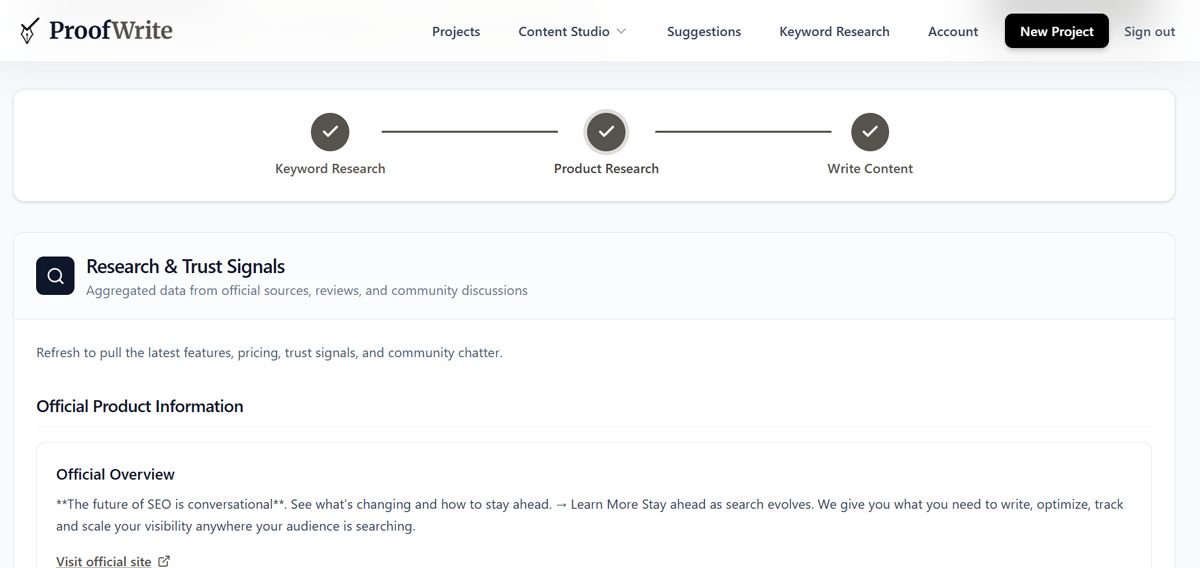
ProofWrite takes a structured approach to research. When you initiate an article, the system performs automated multi-source research before generating text. It scrapes:
Official Product Sites: To get accurate specs and pricing.
Review Platforms: It pulls data from Trustpilot, Capterra, and the BBB etc.
Reddit Discussions: To find real user pain points and "unfiltered" opinions.
Competitor Sites: To see what is currently ranking.
Crucially, ProofWrite includes Trust Signal Aggregation. It automatically pulls real ratings, review counts, and sentiment analysis from 5+ platforms. This allows you to include data-backed statements like "Rated 4.8/5 based on 2,000 reviews," which significantly boosts conversion rates and credibility; something ChatGPT cannot automate.
Can ChatGPT optimize for SEO?
ChatGPT cannot natively optimize for SEO because it lacks access to live keyword metrics. While it can write code and poetry, it is blind to search volume and keyword difficulty unless you feed it that data from a third-party tool.
The "Hidden Cost" of Using ChatGPT for SEO
If you use ChatGPT for blogging, you are likely paying for a separate SEO tool. To get a ChatGPT article to rank, your workflow usually looks like this:
- Pay for Semrush ($139.95/mo) or Ahrefs ($119/mo) to find keywords.
- Copy those keywords into a prompt for ChatGPT.
- Generate the text.
- Paste the text back into an SEO editor (like Surfer) to check if the keywords were actually used.
ChatGPT does not have Live SEO Scoring. It won't tell you whether you've over-optimized (keyword stuffing) or missed secondary keywords (LSI keywords) that help Google understand your topic context.
ProofWrite's Integrated SEO Data
ProofWrite integrates this data directly into the generation process. It features Google Ads keyword research integration, providing real search volume, difficulty scores (0-100), and CPC data.
The system auto-clusters keywords into primary, secondary, and LSI buckets. As the AI writes, it is guided by a Live SEO Score (0-100) across 7 SEO health pillars. This ensures that the article isn't just well-written, but mathematically optimized to compete on the SERP (Search Engine Results Page) from the moment it is generated.
Which tool handles fact-checking and E-E-A-T better?
Google's quality guidelines rely heavily on E-E-A-T (Experience, Expertise, Authoritativeness, and Trustworthiness). Accuracy is non-negotiable, yet this is often cited as Generative AI's biggest weakness.
The Hallucination Problem
ChatGPT is a probabilistic engine; it predicts the next likely word, not the next true fact. While models are improving, they still struggle with specific citations. According to a study by the National Institutes of Health (NIH), up to 47% of AI-generated medical references can be inaccurate or non-existent. Similarly, research from Deakin University found that approximately 1 in 5 citations generated by AI models were fabricated.
If you publish a blog post where ChatGPT invents a statistic or a court case, you risk a manual penalty from Google and a total loss of reader trust.
ProofWrite's Fact-Check System
ProofWrite addresses this with a Built-in Fact-Check System. Because the AI is instructed to ONLY use facts from the initial research data phase, the risk of hallucination is drastically reduced.
The platform provides inline markers that link specific claims back to the source URL found during the scraping phase. You can perform one-click verification to ensure that a price, date, or claim matches the source. Also, the system is E-E-A-T aware by default. The system prompts load Google's quality guidelines (E-E-A-T, Helpful Content, and Product Review guidelines) to enforce factual accuracy and helpfulness structure, rather than requiring you to "prompt engineer" these safety rails yourself.
How do writing quality and humanization compare?
One of the easiest ways to spot an amateur blog post is the "AI accent." If your introduction starts with "Right now of digital marketing..." or uses words like "tapestry," "delve," or "realm," readers know it's a bot.
ChatGPT's Predictable Patterns
ChatGPT has a very specific cadence. It loves balanced sentence structures, overuse of em dashes, and formulaic transitions like "In today's digital landscape" and "Let's dive in." Google's algorithm updates are increasingly adept at identifying these low-effort patterns. While you can prompt ChatGPT to "sound more human," it often reverts to its training weights over the course of a long article.
ProofWrite's Humanization and Personas
ProofWrite includes Humanization Post-Processing as a standard step. This automatically removes AI-telltale patterns, strips out cliché transition words, and varies sentence structure to mimic human writing rhythms.
More importantly, ProofWrite offers a Persona System. You can create custom writing voices based on tone, perspective, and expertise level to match your brand. If you want a "Snarky Tech Reviewer" or a "Professional Medical Consultant," the AI adheres to that persona consistently.
Also, the platform supports Personal Experience Injection. You can add your own first-hand anecdotes or opinions into the brief, and the AI will weave them naturally into the article. This creates the "Experience" factor in E-E-A-T that pure AI usually lacks.
What does the publishing workflow look like?
Time is money. The friction between "generating text" and "hitting publish" is where most content workflows break down.
ChatGPT: The Copy-Paste Bottleneck
ChatGPT is a text generator, not a publisher. Once the text is ready, you have to:
- Copy the text.
- Paste it into WordPress.
- Fix the formatting (H2s and H3s often break).
- Find and upload a featured image manually.
- Add internal and external links manually.
ProofWrite: One-Click Publishing
ProofWrite is designed for volume and velocity. It includes One-Click WordPress Publishing. You can connect your site, and the system handles the formatting, header tags, and even uploads the images automatically.
The platform also supports 13 languages with locale-aware generation, making it easier to scale across international markets without managing multiple translation workflows.
Pricing Breakdown: The True Cost of Content
When evaluating cost, you must look at the total cost of ownership, including the external tools required to make the content viable.
ChatGPT Cost Structure
Free Plan: $0 (Lower limits, no advanced research).
Plus Plan: $20/month (Access to GPT-5.x, Deep Research).
Pro Plan: $200/month (Access to Pro model, Higher limits).
Hidden Costs: To do SEO work, you must add a tool like Semrush ($139.95/mo) or Ahrefs ($119/mo).
Total Monthly Cost:
- ~$150 - $340 per month.
ProofWrite Cost Structure
ProofWrite consolidates the research, writing, and SEO tools into one subscription.
Free Trial: 3 articles (Full features).
Starter: $49/month.
Pro: $139/month.
Business: $349/month.
For a solo blogger or small team, ProofWrite is often significantly cheaper than combining a ChatGPT Plus subscription with a premium SEO tool, while saving hours of manual labor per post.
Who should use which tool?
Use ChatGPT if:
- You are in the brainstorming phase and need ideas.
- You are writing emails, social media captions, or code snippets.
- You have a zero-dollar budget and don't care about SEO data.
- You enjoy the manual process of researching and assembling articles.
Use ProofWrite if:
Your goal is to rank on Google.
- You need to produce detailed product reviews, comparisons, or how-to guides.
- You want to automate the research process (reviews, specs, pricing).
- You want to avoid the "hidden tax" of buying separate SEO tools.
- You need to ensure your content is factually accurate and E-E-A-T compliant.
Frequently Asked Questions
Can ProofWrite replace a human writer?
ProofWrite is designed to replace the grunt work of research, outlining, and drafting, allowing a human to act as an "Editor-in-Chief." While it produces publish-ready content, the best results come when you use the "Personal Experience Injection" feature to add your unique perspective to the AI's solid research.
Does ProofWrite use GPT-5 or other models?
ProofWrite offers a Multi-model choice. You can select the best model for your specific project, including Claude, GPT, or Gemini. The system's "AI Instructions parsing" smartly detects your research directives and style preferences and applies them regardless of the underlying model.
How does ProofWrite help with content strategy?
Beyond writing, ProofWrite includes Article Suggestions. It crawls your existing site to identify content gaps and suggests high-ROI topics that you haven't covered yet, effectively acting as a content strategist.
Is ChatGPT bad for SEO?
ChatGPT itself isn't "bad" for SEO, but unedited ChatGPT content is rarely good enough to rank. Because it lacks keyword data and often produces generic content, it usually requires significant human intervention and external SEO tools to meet Google's standards for helpful content.

Written by
Jussi Hyvarinen - Co-founder of ProofWrite
I built this platform to solve my own frustration with slow research and generic AI. I use it to write every article you see on this blog, including this one.
Publish articles where every claim is checked
ProofWrite researches and writes articles and checks every factual claim against its sources.
Try it on an article you already wrote.
Free Pilot: 1 article and 3 of your own articles. No credit card.