
The search landscape is undergoing its most radical transformation since the invention of the hyperlink. You are no longer just optimizing for a list of blue links; you are optimizing to be the single, definitive answer provided by an artificial intelligence. This shift requires a move from traditional SEO to AEO (Answer Engine Optimization) and GEO (Generative Engine Optimization).
In 2026, users are "asking" rather than "searching." Whether they are using voice search, AI Overviews, or chat interfaces like ChatGPT and Perplexity, the goal is immediate information retrieval without clicking through multiple websites. If your content isn't structured to feed these engines, you risk becoming invisible.
This guide will walk you through exactly how to adapt your content strategy for the AI era. You will learn how to structure data, build authority, and use tools like ProofWrite to ensure your content is ready for the next generation of search.
What is Answer Engine Optimization (AEO)?
Answer Engine Optimization (AEO) is the practice of formatting and structuring web content so that AI-driven search engines can easily identify it as the most direct, accurate, and authoritative answer to a user's question. Unlike traditional SEO, which aims to rank a page, AEO aims to win the "citation" or direct answer slot in AI responses.
Why AEO Matters Now
Traditional SEO focuses on keywords and backlinks to get you on Page 1. AEO focuses on intent and structure to get you into the AI's synthesized answer. When an AI generates a response, it looks for content that is concise, factual, and logically organized. If your content is buried in fluff or difficult for a bot to parse, the AI will skip you in favor of a source that offers a clearer answer.
According to Yahoo Finance, understanding this shift is critical for executives and marketers alike, as visibility in 2026 depends on being the source the AI trusts enough to quote.
What is Generative Engine Optimization (GEO)?
Generative Engine Optimization (GEO) is a subset of optimization specifically designed for Large Language Models (LLMs) and generative search experiences. It involves optimizing content with high-confidence statistics, expert quotes, and authoritative language to increase the likelihood of being cited by generative AI tools when they construct original responses.
The Difference Between SEO, AEO, and GEO
While these terms overlap, their goals differ:
Feature | Traditional SEO | AEO (Answer Engine Optimization) | GEO (Generative Engine Optimization) |
|---|---|---|---|
Primary Goal | Drive traffic to a website via rankings. | Be the direct answer (Featured Snippet/Voice). | Be cited/referenced in an AI-generated summary. |
Target Audience | Human users browsing lists. | Voice assistants and "Zero-Click" searchers. | LLMs (ChatGPT, Gemini, Claude). |
Key Tactic | Keywords, Backlinks, UX. | Q&A formatting, Schema Markup. | Statistics, Expert Quotes, Authoritative Tone. |
Success Metric | Click-Through Rate (CTR). | Position Zero / Voice Answer. | Brand Mention / Citation. |
Step-by-Step Guide: How to Optimize Content for AI Search Engines
To succeed in 2026, you must treat your content as a database of answers. Follow these validated steps to transform your writing for the AI era.
Step 1: Adopt the "Answer First" Format
Action: Structure your content using the "Inverted Pyramid" style, where the direct answer appears immediately after the heading.
Why this is important: AI models are trained to extract information efficiently. If you bury the answer to a question like "How to clean a cast iron skillet" in the fifth paragraph, the AI may deem your content less relevant than a competitor who answers it in the first sentence. Industry insights from Elementor suggest that clear, concise answers at the top of sections are critical for AI retrieval.
How to do it:
- Identify the core question your section addresses.
- Write the heading as that question (e.g., "What is the best time to post on social media?").
- Immediately follow the heading with a 40-60 word direct answer. This is the "snippet" the AI is most likely to grab.
- Expand on the details, examples, and nuances after the direct answer.
Quick Check: Read your heading and the first paragraph. Does the first paragraph answer the heading directly, or is it fluff? If it's fluff, delete it.
Step 2: Implement Structured Data (Schema Markup)
Action: Add specific Schema.org markup to your code to explicitly tell search engines what your content is.
Why this is important: AI crawlers do not "read" pages like humans do; they parse code. Structured data is a standardized format that classifies your content. If you have a tutorial, you must use HowTo schema. If you have a Frequently Asked Questions section, you must use FAQPage schema. This removes ambiguity, making it easier for the AI to ingest your content as a fact source.
How to do it:
- Identify the Content Type: Is it a recipe, a review, a how-to guide, or an article?
- Generate the JSON-LD Code: Use a schema generator tool or a plugin.
- Embed the Code: Place the generated script into the
<head>or<body>of your page. - Validate: Use Google’s Rich Results Test to ensure there are no errors.
Pro Tip: As noted by SEMrush, structured data is one of the most effective ways to communicate context to AI search engines.
Step 3: Optimize for Featured Snippets and "Zero Position"
Action: Format your content using lists, tables, and short paragraphs to target Google's Featured Snippets.
Why this is important: Featured Snippets are the precursors to AI Overviews. Data shows that content currently holding a Featured Snippet is significantly more likely to be used as the source text for an AI-generated answer. By winning the snippet, you position yourself as the primary data source for the AI.
How to do it:
- Use Lists: For "How-to" or "Best of" queries, use numbered (
<ol>) or bulleted (<ul>) lists. AIs love structured lists. - Use Tables: For comparisons (pricing, features, specs), always use an HTML table. AI models can extract data from tables with high accuracy.
- Keep Sentences Simple: Avoid complex jargon unless necessary. Aim for a reading level that is accessible yet authoritative.
Quick Check: Scan your article. Are there walls of text? Break them up with bullet points or bold text highlighting key concepts.
Pro tip: ProofWrite generates HTML tables by default.
Step 4: Utilize Real-Time AEO and GEO Scoring
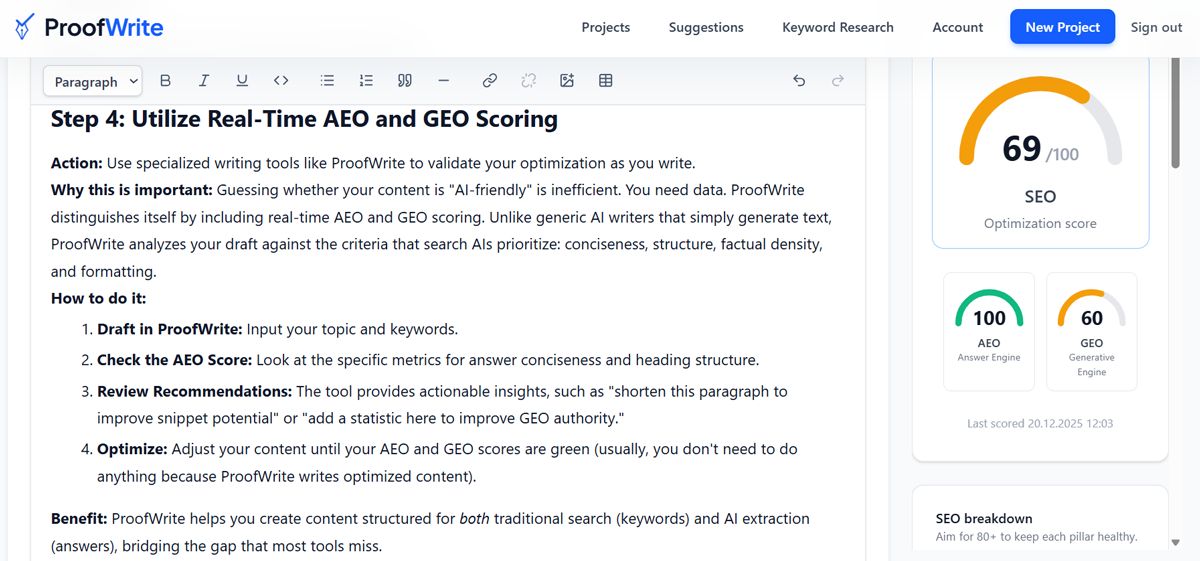
Action: Use specialized writing tools like ProofWrite to validate your optimization as you write.
Why this is important: Guessing whether your content is "AI-friendly" is inefficient. You need data. ProofWrite distinguishes itself by including real-time AEO and GEO scoring. Unlike generic AI writers that simply generate text, ProofWrite analyzes your draft against the criteria that search AIs prioritize: conciseness, structure, factual density, and formatting.
How to do it:
- Draft in ProofWrite: Input your topic and keywords.
- Check the AEO Score: Look at the specific metrics for answer conciseness and heading structure.
- Review Recommendations: The tool provides actionable insights, such as "shorten this paragraph to improve snippet potential" or "add a statistic here to improve GEO authority."
- Optimize: Adjust your content until your AEO and GEO scores are green (usually, you don't need to do anything because ProofWrite writes optimized content).
Benefit: ProofWrite helps you create content structured for both traditional search (keywords) and AI extraction (answers), bridging the gap that most tools miss.
Step 5: Incorporate Visuals for Multimodal Search
Action: Include original images, infographics, and videos, ensuring they are properly tagged with alt text.
Why this is important: Search is becoming multimodal. Users can search by taking a photo, and AI results often display a carousel of images alongside text. Visual content is a key component of AEO, as it provides additional context that text alone cannot.
How to do it:
- Use Descriptive File Names: Instead of
IMG_1234.jpg, useaeo-optimization-diagram-2026.jpg. - Write Contextual Alt Text: Describe the image specifically. "Chart showing the rise of voice search from 2020 to 2026."
- Place Images Near Relevant Text: Ensure the image is physically close to the text that describes it in the HTML structure. This helps the AI associate the visual with the answer.
Step 6: Build Authority with Citations and Statistics
Action: Support every claim with a statistic, a study, or a quote from a recognized expert.
Why this is important: Generative Engine Optimization (GEO) relies heavily on "Information Gain." AI models prioritize content that adds new value rather than just repeating what everyone else says. By including unique data or citing authoritative sources, you signal to the LLM that your content is factually grounded and trustworthy.
How to do it:
- Cite Original Research: If you have proprietary data, use it.
- Reference Reputable Sources: Link to government bodies, educational institutions, or major industry reports.
- Use "According to..." Phrasing: Explicitly attribute facts. For example, "According to Iconier, AEO requires a fundamental shift in how we structure data."
Quick Check: Look at your subheadings. Do the paragraphs following them contain at least one hard fact or statistic? If not, the AI may view the section as opinion rather than fact.
Step 7: Maintain Content Freshness
Action: Update your content regularly to reflect the latest data, years, and trends.
Why this is important: AI models have "cutoff dates" for their training data, but live search engines (like Bing Chat or Google AI Overviews) prioritize recency. If your article is titled "Best SEO Tips 2023," it will be ignored in 2026. Regular updates signal relevance.
How to do it:
- Audit Quarterly: Review your top-performing AEO content every three months.
- Update Dates: Ensure the title and metadata reflect the current year.
- Refresh Statistics: Replace outdated stats with the newest available numbers.
Troubleshooting Your AEO Strategy
Even with the best intent, optimization can fail. Here is how to troubleshoot common issues.
Problem: My content is not appearing in AI Overviews.
- Cause: Your answer might be too long or unstructured.
- Fix: Review the "Direct Answer" section under your heading. Is it under 60 words? Is it objectively written (no "I think" or "In my opinion")? Rewrite it to be purely factual.
Problem: I am ranking in search but not being cited by Chatbots.
- Cause: Lack of authority or brand mentions.
- Fix: Focus on GEO strategies. Increase your digital PR efforts to get your brand mentioned on other authoritative sites. LLMs rely on the "consensus" of the web; if others cite you, the AI will too.
Problem: My Schema is not validating.
- Cause: Syntax errors in the JSON-LD code.
- Fix: Use the Google Rich Results Test. It will pinpoint exactly which line of code is broken. Often, it is a missing comma or an unclosed bracket.
Frequently Asked Questions
What is the difference between AEO and SEO?
AEO (Answer Engine Optimization) focuses on optimizing content to provide direct answers for AI and voice search, targeting the "position zero" or citation slot. Traditional SEO focuses on optimizing content to rank higher in a list of search results (SERPs) to drive clicks to a website. AEO is about being the answer; SEO is about being the destination.
How do I optimize for Google's AI Overviews?
To optimize for AI Overviews, focus on answering user questions concisely (40-60 words) immediately after a heading. Use structured data (Schema), bullet points, and tables to make data easy to extract. Ensure your content demonstrates E-E-A-T (Experience, Expertise, Authoritativeness, and Trustworthiness) so the AI trusts your data.
Why is structured data important for AI search?
Structured data (Schema markup) acts as a translator for AI. It explicitly labels parts of your content (e.g., "this is a recipe," "this is a price," "this is a FAQ"), allowing AI crawlers to understand and index your content's intent and details accurately without guessing.
Does ProofWrite help with GEO?
Yes. ProofWrite includes specific GEO scoring that analyzes your content for authoritative signals, statistical density, and structural clarity; key factors that Generative AI engines use when selecting sources to cite. It helps you bridge the gap between human-readable content and machine-readable data.
Conclusion
The transition to AI-first search is not a trend; it is the new standard for information retrieval. By 2026, the brands that succeed will be those that stop writing solely for clicks and start writing for answers.
Optimizing for AEO and GEO requires a disciplined approach: structuring your data, answering questions directly, and validating your authority with facts. It is a shift from "creating content" to "managing knowledge."
Start by auditing your high-traffic pages today. Implement the direct answer format, add the necessary schema, and verify your optimization scores using tools like ProofWrite. By making your content accessible and understandable to AI, you ensure your voice remains authoritative and visible in the age of answer engines.

Written by
Jussi Hyvarinen - Co-founder of ProofWrite
I built this platform to solve my own frustration with slow research and generic AI. I use it to write every article you see on this blog, including this one.
Publish articles where every claim is checked
ProofWrite researches and writes articles and checks every factual claim against its sources.
Try it on an article you already wrote.
Free Pilot: 1 article and 3 of your own articles. No credit card.