
The full methodology behind ProofWrite's Citation Readiness score: how fact checking, claim-bound citations, and the editor's scoring gauges connect into one verification pipeline. Every formula on this page matches the implementation. Companion to Ranking Is No Longer Enough, which covers the strategy; this page covers the mechanics. Last updated August 2026.
Ranking, being retrieved by an AI system, and being cited in its answer are three different outcomes — Ranking Is No Longer Enough makes that case in full. The gap between the last two is the one this page is about: AirOps analyzed ChatGPT's retrieval behavior and found that about 85% of the pages ChatGPT retrieved never got cited in the final answer. The system found those pages, read them, and passed them over. Being findable was not the bottleneck. Being worth citing was.
That gap is worth engineering for, not just hoping for — the visitors who do click through from AI answers arrive late in their decision, and one Search Engine Land analysis of a commerce dataset reported LLM referral traffic converting at roughly 20%, dramatically better than paid search in the same data.
This page explains how ProofWrite does that engineering: what the fact-check pipeline verifies, how citations get bound to the claims they support, and how both feed a score we call Citation Readiness — including the exact formula, and the things we deliberately refuse to score.
Retrievable is not citable
When a generative engine composes an answer, it has a pile of retrieved documents and a decision to make: which ones earn a citation? Reverse-engineering studies of ChatGPT's retrieval stack (such as RESONEO's analysis) and the behavior visible across engines suggest the winners share a recognizable profile:
- Self-contained claims. Statements that survive being lifted out of context. "Pricing starts at $99/month for up to 5 seats" can be quoted alone; "it's cheaper than most alternatives" cannot.
- Receipts. The claim and its supporting source travel together. A statistic with a link to the primary source is a safer thing for an AI to repeat than the same statistic floating free.
- Authority. Evidence that traces to primary and official sources, not to another blog that also cited no one.
- Freshness where it matters. Pricing, policies, and version-dependent facts backed by sources from the right time period.
None of this is exotic. It is what a careful editor has always wanted. What's new is that these properties are now selection criteria in an automated pipeline that decides, millions of times a day, which documents get quoted.
What we refuse to build: a "ChatGPT ranking score"
Before describing what Citation Readiness measures, it's worth being explicit about what it does not claim.
AI citation behavior is strongly platform-specific. In Kevin Indig's H1 2026 dataset, 91% of the AI citations examined appeared on only one platform, a page cited by ChatGPT was usually not the page cited by Perplexity or Google AI Overviews for the same intent. Any tool that shows you a single number and calls it your "AI visibility score across all engines" is measuring something it cannot measure.
So Citation Readiness makes a narrower, honest claim: it measures properties of your document that plausibly increase its odds of surviving the retrieval-to-citation cut, on any engine — the profile above. It does not predict citations, does not simulate any specific engine, and does not pretend the weights were fitted to AI logs (they are editorial choices, stated below). We think a narrow true claim beats a broad false one.
The pipeline: research → bound citations → per-claim verification
Citation Readiness is not a checker bolted onto finished text. Most of its inputs exist because of how the article was produced in the first place.
Research before writing. Every ProofWrite article starts by collecting and reading sources: official pages, documentation, editorial coverage, community discussion — before a word is drafted. The writer works from an evidence registry, not from the model's memory, which is what makes claims specific enough to be citable at all.
Citations bound to claims, not sprinkled on top. All source linking runs through a shared claim-support engine with one rule: an approved URL is not enough; the URL must support the specific claim it is attached to. The engine tracks which claim families carry the most risk, like pricing, API capabilities, policies, legal and technical facts and flags a numeric claim that lost its citation, an anchor placed on weak text, or a named source that never got linked. Citation problems are fixed by repairing the citation, not by deleting the supported claim.
Fact checking at sentence level. After writing, the fact-check engine extracts claims as complete article sentences (so no reader ever sees a de-contextualized clause presented as "your claim") and classifies each one: does it require external evidence, is it common knowledge, is it the author's own experience? Evidence-required claims get a source search, and each piece of evidence is classified on three axes:
- Semantic relation — does the source actually entail the claim, partially support it, or contradict it?
- Source authority — primary, authoritative, secondary, or unknown.
- Temporal applicability — does the source's content apply to the claim's current timeframe? A 2023 pricing page "supporting" a 2026 pricing claim is flagged as mismatched, regardless of when we fetched it.
Claims end up supported, needing review, unsupported, or contradicted — and repairable problems flow back into an automated repair step that edits the exact offending span, never the surrounding prose.
The score: surface signals plus verified signals
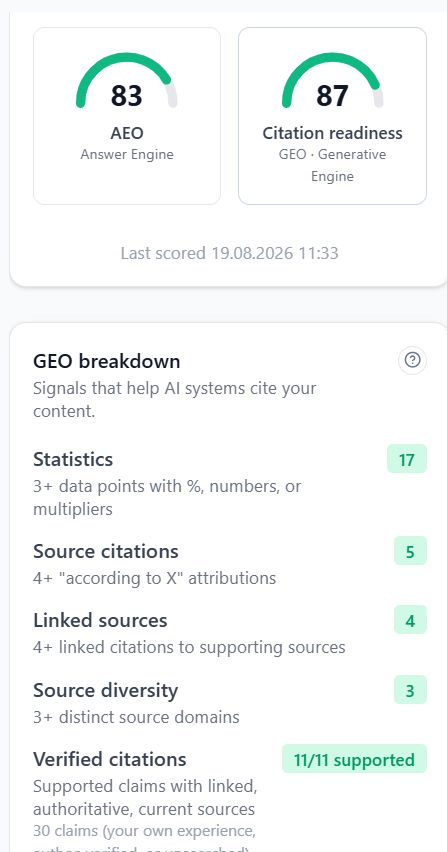
ProofWrite's editor shows three gauges: SEO (classic ranking factors), AEO (answer-engine structure: question headings, 18–90-word direct answers, FAQ and summary sections), and Citation Readiness.
Citation Readiness has two layers, and the distinction is the point.
Surface signals are what any tool can measure from the text alone: statistics density, "according to X" attributions, linked sources and their domain diversity, first-hand experience markers, quotable 12–45-word factual statements. Our free SEO checker measures exactly these for any URL. They are useful and they are also imitable, both by competing tools and by content that fakes the pattern without the substance.
Verified signals exist only because the same system wrote, cited, and fact-checked the article. After a completed fact check, the verification component of the score becomes a composite of four factors:
Factor | Weight | What it measures |
|---|---|---|
Support ratio | 50% | Share of extracted claims verified as supported, minus a penalty for open issues |
Receipts linked | 25% | Of the verified evidence-required claims, how many link their supporting source in the body, where the claim is made |
Evidence authority | 15% | Share of authority-classified evidence that is primary or authoritative (target: at least half) |
Temporal match | 10% | Share of time-sensitive claims whose evidence comes from the right time period |
Three design rules keep the composite honest:
- Empty denominators are neutral, never penalties. An article with no risky claims has nothing to cite and loses nothing.
- Hand-reviewed claims don't drag the score. When the author verifies a claim manually, it is resolved for that exact report — and only that report. A rerun or article change invalidates the verification along with it.
- Without a completed fact check, the score falls back to surface signals and says so. It never pretends verification happened.
In the editor this surfaces as three lines under the gauge, claim receipts linked (say, 6/8), primary-source evidence share, time-period match — with recommendations that name the actual fix: link the supporting source where the claim is made, replace secondary evidence with the primary source, refresh the citations behind time-sensitive claims.
Honest limitations
- No engine owes you a citation. These signals raise the odds of surviving the citation cut; they guarantee nothing, and citation behavior differs per platform and per query.
- The weights are editorial, not fitted. 50/25/15/10 encodes our judgment that verified support matters most and temporal freshness least among the four — not a regression on AI citation logs, which no one outside the platforms has at claim level.
- Verification has a scope. The fact check verifies claims against retrievable public sources at check time. A source can change after the check; time-sensitive claims are flagged as such precisely because of this.
- Zero-click exposure is real. Browsing-data research on Google's AI Overviews found cited sources were clicked in only about 1% of AI Overview impressions. Citations build presence and brand recall more often than they build sessions. We think the presence is worth having, the high-intent minority that does click appears to convert unusually well, but we won't sell it as a traffic strategy.
What this means for how you write
If you strip away the pipeline, the practical guidance is portable to any workflow:
- Make your strongest claims specific enough to quote alone: numbers, names, dates.
- Put the supporting link at the claim, not in a bibliography ten scrolls away.
- Prefer the primary source over the blog that summarized it.
- Date-check the evidence behind anything that changes: prices, policies, limits, versions.
- Verify before publishing, and fix the citation rather than deleting the claim it supports.
Ranking got you into the retrieval pool. Citation Readiness is our attempt to measure honestly, with the receipts attached — whether you deserve to make it out.

Written by
Jussi Hyvarinen - Co-founder of ProofWrite
I built this platform to solve my own frustration with slow research and generic AI. I use it to write every article you see on this blog, including this one.
Publish articles where every claim is checked
ProofWrite researches and writes articles and checks every factual claim against its sources.
Try it on an article you already wrote.
Free Pilot: 1 article and 3 of your own articles. No credit card.