
Katteb calls itself the world's first fact-checked AI writer. Since fact-grounded article generation is exactly what ProofWrite is built for, that claim earned a proper test: we gave both tools the identical brief, "How to Set Up GA4 Conversion Tracking for an E-commerce Store," and compared what came out the other end, section by section.
Full disclosure up front: ProofWrite is our product, so read this knowing where we stand. To keep the comparison honest, everything below is anchored to the two actual outputs, we quote both articles directly, and we call out the places where Katteb genuinely does something we don't.
The Test Setup
Both tools received the same how-to title. ProofWrite ran with its standard how-to pipeline on the medium length setting (a 1,500–3,000 word planning range). Katteb ran with its article generator set to a 1,500-word target, default writing style, SEO optimization on.
Two things we measured before even reading the prose:
ProofWrite | Katteb | |
|---|---|---|
Length setting | Medium (1,500–3,000 words) | 1,500 words (explicit target) |
Actual output | ~3,400 words | 3,073 words |
Deviation | Near the top of its declared range | More than double the requested target |
Neither tool was perfectly disciplined. ProofWrite landed at the ceiling of its range and nudged past it. But there's a difference between filling out the top of a declared range and doubling an explicit number the user typed into a box. If you asked for 1,500 words because your content plan calls for 1,500 words, getting 3,073 back means the setting didn't do anything.
Then we read both articles closely. That's where the gap stopped being about word counts.
What the Articles Actually Contained
ProofWrite: a guide you can follow with your hands on the keyboard
The ProofWrite article is structured as a working implementation guide: a prerequisites checklist, eight numbered steps in build order, and a verification pass at the end. Every step names the exact place in the GA4 interface where the work happens (Admin > Data Streams, Admin > Events), and most steps end with a quick check that confirms the step worked before moving on.
It includes the things a technical reader will look for first:
- Working code examples. Complete
gtag.jssnippets foradd_to_cartandpurchaseevents, plus the equivalentdataLayer.pushstructure for Google Tag Manager users. - A parameter reference table mapping each ecommerce event to its required item-level and event-level fields.
- Specific numbers with sources. The 30-conversion property limit, the 24–48 hour reporting delay, a 95% backend-reconciliation target, and ISO 4217 currency codes all include inline links to Google's own documentation at the exact claims they support.
- A troubleshooting section listing the seven most common implementation failures, ordered by how often they occur, each with a diagnosis path.
Katteb: an essay about the topic, not a guide through it
The Katteb article covers the same subject headings but stops there. Across 3,073 words there is not a single code example, not one snippet of gtag.js or a data layer structure, and not one concrete click path in the GA4 interface. The core task promised by the title, actually marking an event as a conversion, is never shown. The article's advice stays at the altitude of "Enable Enhanced Measurement within the GA4 property settings and confirm that automatic events align with your shop layout." Where? Which toggle? What should you see when it works? The article doesn't say.
The prose also follows a visible template: nearly every subsection is one abstract topic sentence followed by three consultant-style bullets ("Establish governance around event definitions…", "Conduct daily 1:1 reconciliations…"). In several places it also produces terminology that doesn't exist in GA4 or anywhere else. It instructs readers to use a "redraw window" to compare order IDs, to "suppress repeat POI firing," and to route events to a "pII-safe queue." These aren't obscure pro techniques. They're plausible-sounding artifacts of text generation, and a reader who follows the guide will search for them and find nothing.
The export had mechanical problems too: raw CSS style rules leaked into the top of the document, the table of contents collapsed into a single unbroken line, and the references arrived as a run-together list of titles with no URLs.
The Fact-Checking Claim, Tested
This is the comparison we most wanted to make because, to our knowledge, Katteb is the most prominent AI writer besides ProofWrite that puts fact-checking at the center of its pitch. Katteb's site promises automatic in-text citations from trusted sources: patent references, expert quotes, authoritative links woven into the article.
Here's what the head-to-head showed:
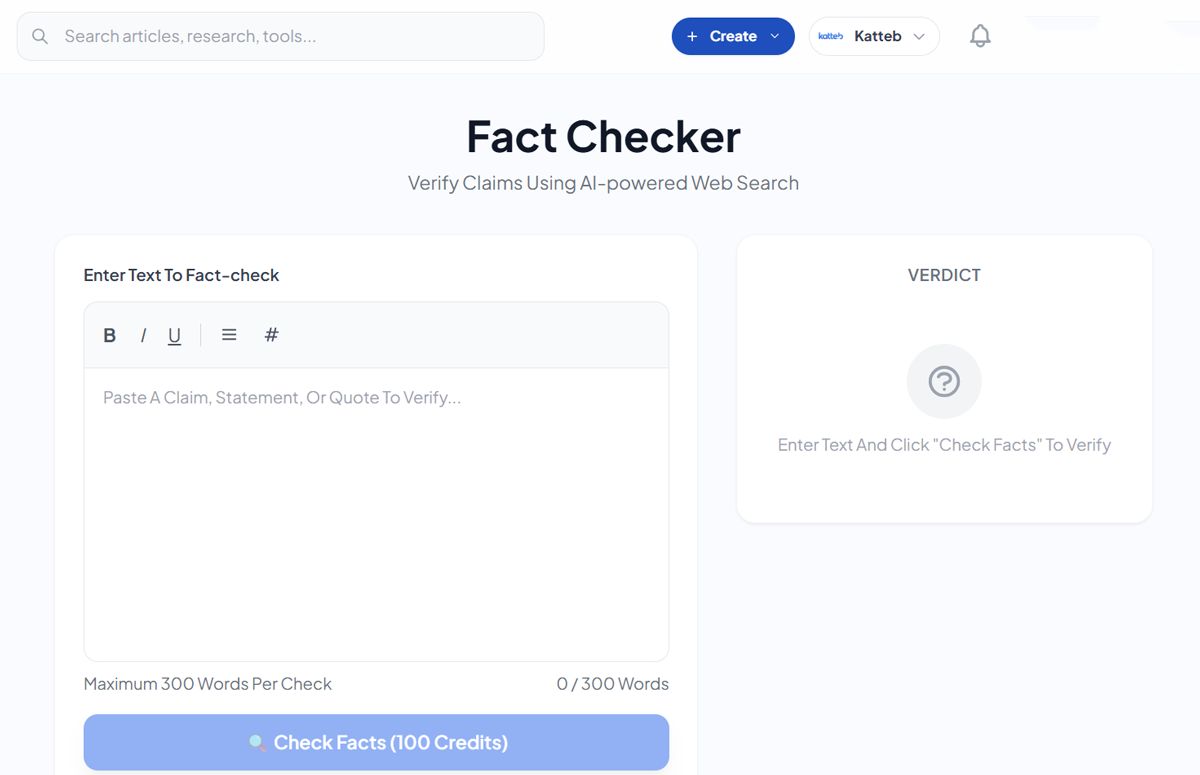
Katteb's generated article contained zero inline citations. The claims in the body are unlinked, and the references section at the end is a list of article titles without URLs. There is no way to trace any specific claim back to any specific source. The fact-checking capability that does exist in the product is a separate tool: you paste a passage (up to 300 words) into a Fact Checker page, spend credits, and get a verdict. It's a manual spot-check you run on text after the fact, one excerpt at a time, disconnected from article generation.
ProofWrite's article carried its evidence inline. Claims about event parameters, conversion limits, and setup behavior link directly to Google's developer documentation and Analytics Help pages at the sentence where the claim is made, and the references section lists the sources that survived into the final article.
This isn't a separate button. Research, source vetting, claim-support checking, and citation placement are stages of the same pipeline every article goes through. A claim that no approved source supports doesn't get to keep its link; a source that supports nothing doesn't make it into the article.
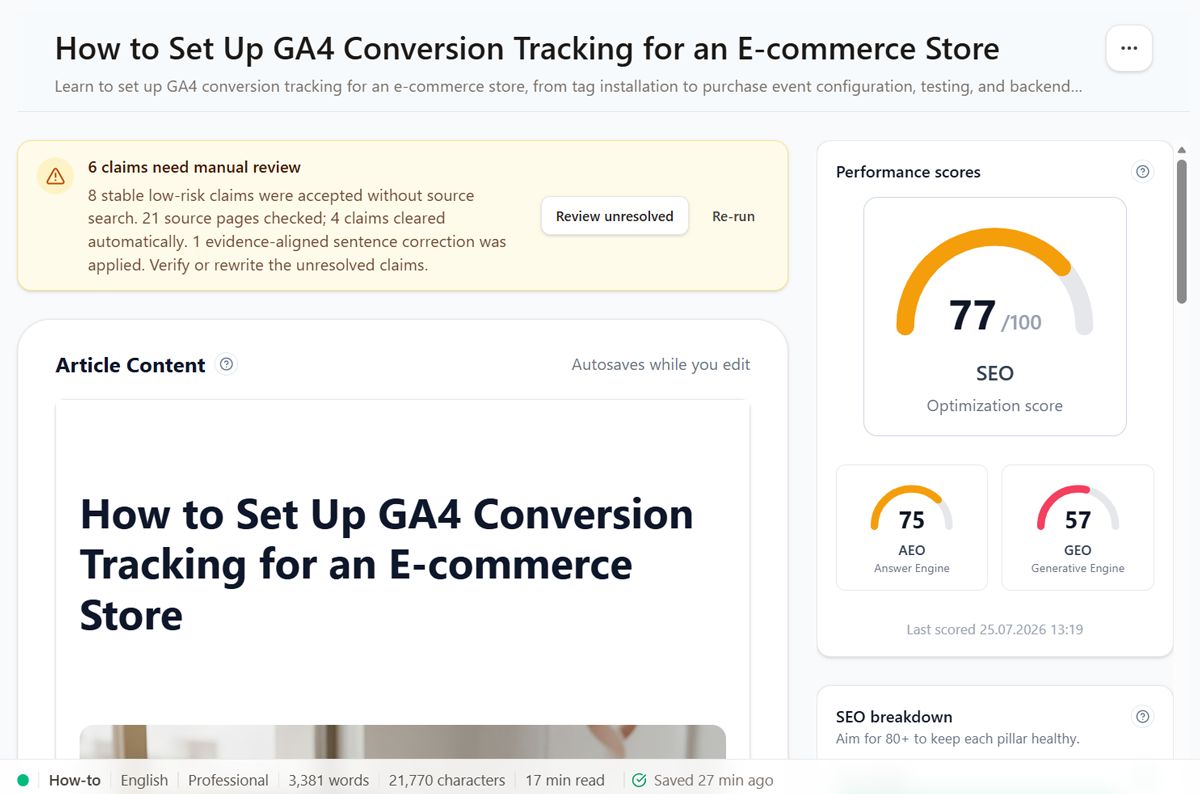
And then the fact-check runs itself. When the article is finished, a dedicated fact-check agent automatically sweeps the entire article, claim by claim, against the source pages gathered during research. There is nothing to paste and no excerpt limit. On this test article, the agent checked 21 sources, cleared 4 claims automatically, and flagged 6 for review directly in the editor, each one waiting with its evidence so you verify or rewrite it in place. You don't have to remember to run it, and it can't skip the parts you didn't paste.
The distinction matters for a simple reason: fact-checking that depends on the user remembering to paste passages into a checker is fact-checking that mostly doesn't happen. On a 3,000-word article, checking every passage 300 words at a time would take ten manual rounds per article. A whole-article check that runs automatically on completion is a different category of feature, even before comparing the results.
Where Katteb Is Genuinely Ahead
A comparison that only lists wins for the home team isn't worth publishing, so here is what we'd honestly credit Katteb with:
- Google Search Console integration. Katteb's Content ROI view connects to GSC, tracks how published articles perform in search, and can flag declining content for a refresh. ProofWrite doesn't have a Search Console integration today, and for a content team that measures output by rankings, that's a real workflow advantage.
- In-editor competitor benchmarking. Katteb's SEO panel scores the draft live against the pages currently ranking for the target keyword, with word count, headings, and entity coverage shown next to competitor averages. To be clear about what's being credited here: both products score SEO (ProofWrite grades every finished article with an SEO gauge, and adds AEO and GEO scores for answer-engine and generative-engine visibility, which Katteb doesn't measure at all). The part that's genuinely Katteb's is the side-by-side competitor averages inside the editor, and some writers will like that feedback loop.
- Breadth of tooling. One-click WordPress publishing with scheduling, 60+ output languages, plagiarism checking, and a free plan to try it all, with paid plans starting around $17/month. It's a wide toolbox at an accessible price.
None of that is small. But notice what the list has in common: it's all instrumentation around the article. The article itself, the thing that gets published under your name, is where the test showed the widest gap.
Our Scores
We graded both outputs on the school scale of 4–10, on the criteria that matter for a how-to: could a reader complete the task, are the claims traceable, and could you publish it without a rewrite?
ProofWrite: 8/10. A publishable implementation guide with working code, exact UI paths, sourced claims, and a troubleshooting section that needs only light copyediting. Not a 9, honestly: it ran to the very top of its length range, and our review caught a handful of small mechanical errors (a stray space inside a domain name, two mid-sentence capitalization slips). We traced each of those to its root cause in our post-processing pipeline and shipped fixes the same day. That fact makes its own point about the two products: an integrated pipeline is something you can debug and permanently improve.
Katteb: 5/10. The structure is logical, the FAQ section is a nice SEO touch, and nothing in it is outright factually wrong; it's vague rather than incorrect. But it doesn't deliver what its own title promises: no code, no concrete steps, no citations, invented jargon, double the requested length, and an export that needs manual cleanup before it could go anywhere near a CMS. It reads like an article about GA4 conversion tracking, written for a search engine. To make it publishable, you'd essentially rewrite it. At that point, the tool has saved you an outline.
The Takeaway
Katteb is a broad, affordably priced content toolkit with some instrumentation we genuinely respect, especially the Search Console loop. But "fact-checked AI writer" turned out to describe a feature you can visit, not a property of the articles it writes. In our head-to-head, the fact-checking was a separate credit-metered page, and the generated article shipped with no citations at all.
ProofWrite's bet is the opposite one: verification isn't a tool in the sidebar, it's the pipeline. Research happens before writing, sources are vetted before they're cited, every claim-supporting link is checked before the article reaches you, and a fact-check agent then verifies the finished article claim by claim, automatically, with no word limit and nothing to paste. On the same brief, that difference produced one article a store owner could follow end to end and one they couldn't.
The best part of running this comparison? Anyone can reproduce it. Take a topic you know deeply, run it through both tools, and read the two outputs as the expert you are. That test costs one article credit and settles the question better than any vendor's blog post, including this one.

Written by
Jussi Hyvarinen - Co-founder of ProofWrite
I built this platform to solve my own frustration with slow research and generic AI. I use it to write every article you see on this blog, including this one.
Publish articles where every claim is checked
ProofWrite researches and writes articles and checks every factual claim against its sources.
Try it on an article you already wrote.
Free Pilot: 1 article and 3 of your own articles. No credit card.